





Imagine you live 45 minutes from the nearest bank branch. You work two jobs, both with rigid hours. You need a small loan to repair your car, the one thing keeping those jobs accessible. You walk into a CDFI office on your lunch break, wait in line, get handed three forms, and are told to come back with additional documents.
You do not go back.
This is not a hypothetical. It is the reality for tens of millions of Americans who sit outside the traditional financial system, not because they are irresponsible, but because access itself is the barrier. CDFIs exist precisely to fix this. But they face a structural problem that has nothing to do with intention: physical branches are expensive to build, expensive to staff, and geographically limited by definition.
Video changes that equation entirely.
What CDFIs Are Actually Up Against
Community Development Financial Institutions (credit unions, community development banks, loan funds, and venture capital funds certified by the U.S. Treasury) were built to reach underserved communities. Low-income neighborhoods. Rural counties. Minority populations historically locked out of mainstream credit.
The mission is clear. The mechanics are hard.
A single branch costs anywhere from $500,000 to over $2 million to set up, and that is before you factor in staffing, security, and compliance overhead. For a CDFI operating on thin margins and mission-first capital, opening five branches to cover a rural state is simply not an option. So you open one, or two, and serve whoever can physically reach you.
The unbanked population, roughly 5.9 million U.S. households according to the FDIC’s most recent survey, is not evenly distributed near those branches. They are disproportionately in places where branches do not go: remote rural areas, dense urban pockets without accessible transit, tribal lands, communities that simply never had financial infrastructure built in.
That geographic mismatch is the problem video banking directly solves.
Video Is Not Just “a Digital Channel.” It Is Presence.
There is a reason phone banking never fully replaced in-person service for complex financial decisions. Voice is transactional. It handles balance checks and payment confirmations. But when someone is applying for their first-ever loan, or trying to understand a credit product for the first time, or navigating a hardship restructuring, they need to feel like they are talking to a person who sees them.
Video delivers that. A face, a name, eye contact, the ability to hold up a document and say “is this what you need?” These things matter enormously when you are building trust with someone who has historically been let down by financial institutions.
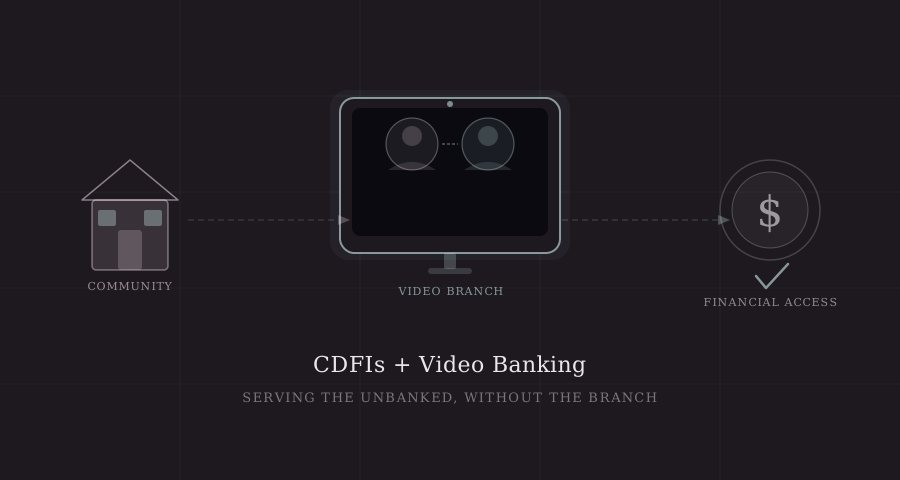
A video branch replaces the physical office visit with a live, face-to-face session that a member can initiate from their phone, a library kiosk, a community center tablet, or a partner organization’s location. The CDFI’s officer does not need to be in the same county. The member does not need to take a day off work.
That is not a lesser experience. For many people, it is a better one.
The Specific Ways CDFIs Can Deploy Video Banking
1. Remote Loan Origination Without Physical Barriers
Loan origination is where CDFIs do their most important work and where friction causes the most dropout. An application that requires three in-person visits loses applicants who cannot afford those visits.
Video banking enables the entire origination conversation to happen live and remotely. A loan officer can walk an applicant through the product, review documents shared on screen, answer questions in real time, and build the human relationship that makes someone feel comfortable enough to complete the process. No branch visit required.
2. Identity Verification That Is Actually Accessible
Know Your Customer (KYC) requirements are non-negotiable, but they do not have to mean “come in with your ID.” Video ident allows CDFIs to conduct compliant identity verification through a live video session, where an officer can verify a government-issued ID in real time, confirm liveness, and complete the process in minutes.
For a population that is already wary of institutions, removing the friction of an in-person ID check is not a small thing. It is often the difference between someone completing an account opening and abandoning it.
3. Credit Counseling and Financial Education at Scale
CDFIs often provide financial literacy services alongside credit products. These sessions (budget reviews, credit-building coaching, debt restructuring conversations) are deeply personal and benefit enormously from a face-to-face format.
With video, a single counselor can serve members across an entire state in a day. Session scheduling, routing, and follow-up can all be managed in one system. The member gets the same quality of attention they would receive in a branch office, and the CDFI does not need to hire staff in every geography it serves.
4. Ongoing Relationship Management for Existing Members
The relationship does not end at loan disbursement. Delinquency prevention, refinancing discussions, and cross-product education all benefit from periodic human touchpoints. Video credit verification and PD sessions give CDFIs a structured, documented way to maintain those touchpoints without requiring branch visits, which members in underserved areas are unlikely to make consistently.
The Trust Layer That Other Channels Cannot Provide
There is a reason video works where text and voice fail for this particular population.
Distrust of financial institutions among unbanked and underbanked communities is well-documented and entirely rational, given the history. Predatory lending, redlining, discriminatory underwriting. The reasons people have stayed out of the financial system are real.
Rebuilding that trust requires more than a clean app and a good interest rate. It requires a person. It requires the ability to look someone in the eye, even through a screen, and say, “I am here, I understand your situation, and I am going to help you.” That is what video as the trust layer in digital banking journeys means in practice for a CDFI.
Text-based chat cannot carry that weight. An FAQ page certainly cannot. Video, with a real officer on the other side, can.
What CDFIs Need to Make This Work
Deploying video banking is not just a technology purchase. A few things have to be in place for it to actually serve the mission.
Smart routing. Not every member who joins a video queue has the same need. Someone applying for a microloan needs a different officer than someone seeking emergency rental assistance. Customer journey and routing tools ensure members reach the right person without bouncing through a confusing menu system that reminds them of every bad IVR experience they have ever had.
Visibility into what is working. CDFIs are accountable to funders, regulators, and communities. They need to demonstrate impact, not just activity. Dashboards and reporting that track session volumes, outcomes, completion rates, and member demographics give leadership the data to report on mission effectiveness and identify where service gaps still exist.
Accessibility considerations. If video banking is going to serve genuinely underserved populations, it needs to work on low-end smartphones, over slower connections, and in environments that are not ideal. This is a technical requirement, not an afterthought.
Partner location integrations. Not every unbanked person has a reliable smartphone or private internet access. CDFIs can deploy video banking through trusted community partners (libraries, churches, community health centers, workforce development organizations) where members can access a private, connected device for their video session. This turns community partnerships into service delivery infrastructure.
The Cost Math Is Different Now
Here is the bottom line for CDFI leadership: a video banking program serves members across a multi-state geography with a staffing footprint that a single branch used to require. You do not eliminate the need for human officers. You dramatically increase how many members each officer can serve and where they can serve them.
Operating cost per member interaction falls. Geographic reach expands. The branch becomes a coordination hub rather than the only point of contact.
For a CDFI trying to justify its community development impact to a Treasury reviewer or a CDFI Fund grant committee, “we served members across 14 counties without opening a single new branch” is a compelling data point. It is also just the truth of what video makes possible.
Who This Is Already Working For
Credit unions in rural states have been among the early adopters of video banking specifically because the geography problem is so acute. A single-branch credit union serving a three-county area can use video to reach members who would otherwise have no meaningful access to financial services. The conversations happening in those sessions are not basic. They are loan restructuring, membership education, and first-account openings for people who have never held a bank account before.
The mission-driven context of CDFIs actually makes video banking more effective, not less. Members who are already hesitant about institutions respond well to an officer who takes time, explains clearly, and is visibly present. Video creates that space in a way that an automated process cannot.
The Unbanked Do Not Need More Automation. They Need More Access.
The prevailing assumption in fintech has been that the answer to financial inclusion is better apps and smarter algorithms. For some populations, that is true. But for the communities CDFIs serve, people who distrust institutions, who have limited digital literacy, who have been burned before, the answer is more human contact, not less.
Video banking is how you deliver that human contact at the scale and cost structure that a mission-driven institution can actually sustain.
The branch is expensive. The gap it was meant to fill is real. Video closes that gap without the overhead, and without asking underserved communities to meet an institution halfway when they have already been asked to do that for generations.
Interested in how VideoCX helps CDFIs and credit unions serve more members remotely? Explore our video banking solutions built for community financial institutions at us.videocx.io.