




Here’s a question that divides banking technology teams: Should your video banking platform require customers to download a dedicated app, or should it work seamlessly in their web browser?
The answer isn’t “one or the other.” The answer is both. And here’s why that matters more than you might think.
The Reality of Customer Behavior
Let’s start with what customers are actually doing. According to a 2024 survey, 55% of U.S. consumers use mobile apps as their top banking channel, while 22% use online banking via PC as their primary method. At first glance, this looks like a clear win for mobile apps.
But dig deeper and you’ll find something interesting. Browser-based banking still represents 12% of total banking access, and it’s particularly important for business accounts and specific customer segments. More importantly, this 12% isn’t about preference. It’s about convenience and accessibility.
The real insight? Customers don’t want to choose between browsers and apps. They want to use whatever is convenient at the moment.
Why App-Only Video Banking Creates Friction
Let’s walk through a common scenario. A customer is browsing your bank’s website on their laptop. They see information about a new investment product and want to speak with an advisor. They click “Connect with an Advisor,” and then they see: “Please download our mobile app to connect via video.”
What happens next? Studies show that 43% of users abandon an onboarding process due to friction related to identity verification and app downloads. That’s nearly half your potential video banking users gone before the conversation even starts.
The friction compounds when you consider:
Device Switching: The customer was on their laptop. Now they need to pick up their phone, search for your app in the app store, download it (using up storage space), create an account or login, navigate to the video banking section, and then finally connect. By this point, many customers have moved on.
Storage Constraints: The average smartphone user has 40 to 60 apps installed. Many customers are reluctant to download yet another single-purpose app, especially if they only need video banking occasionally.
Immediate Need: When a customer wants to discuss something, they want to do it now. Not in five minutes after downloading an app. The moment has passed, and so has the opportunity.
Multiple Devices: Customers browse your website from multiple devices. Desktops at work, tablets at home, phones on the go. An app-only approach means they can only access video banking from one device.
Why Browser-Only Video Banking Has Limitations
On the flip side, browser-only video banking isn’t the complete solution either. Mobile browser experiences aren’t always optimal on small screens. For banks with robust mobile apps, video banking feels disconnected if it only works in a separate browser session. Some advanced features like seamless camera switching work better in native apps. And customers who frequently use video banking may prefer the convenience of a native app icon rather than bookmarking a URL.
The Best Solution: Offer Both
The most effective video banking platforms give customers choice. Here’s what that looks like in practice:
Browser-Based Access for Universal Reach
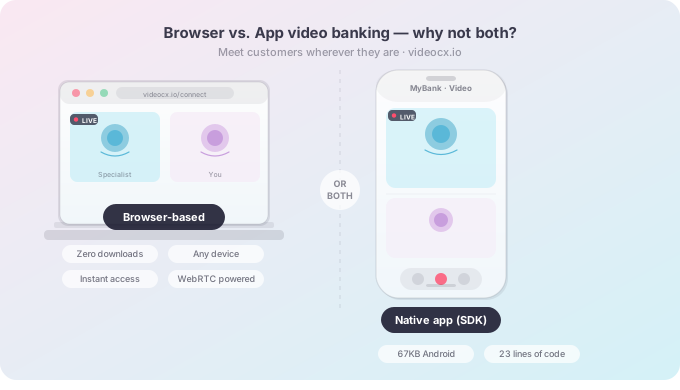
Browser-based video banking should be your foundation. It works across all devices and operating systems with zero downloads. A customer on a Windows laptop, a Chromebook, a Mac, or even a tablet can instantly connect with a video banker.
Modern browser-based video calling uses WebRTC technology, which enables high-quality video without plugins or downloads. Customers using Chrome or Safari (the two dominant browsers) get a seamless experience.
This is particularly important for:
- Customers researching products: Someone browsing your website who has questions can connect immediately
- Business banking: Companies often access banking from work computers where app downloads may be restricted
- First-time users: Customers trying video banking for the first time don’t need to commit to an app download
- Older demographics: Many customers over 55 are more comfortable with web browsers than managing multiple apps
Native App Integration for Frequent Users
For customers who already use your mobile banking app daily, video banking should be seamlessly integrated. This is where WebView SDKs come in.
A WebView SDK allows video banking functionality to be embedded directly into your existing mobile app. The customer experience is native. They don’t leave your app, don’t need to download anything additional, and the video calling feels like a built-in feature.
The best WebView SDKs are lightweight. For example, a well-designed SDK might be just 67KB on Android and 350KB on iOS, requiring only 23 lines of code to implement. This means minimal impact on your app’s size and performance.
Native app integration is ideal for:
- Daily banking customers: Those who already live in your mobile app for transactions and account management
- Complex transactions: Multi-step processes like loan applications that benefit from app-based document upload and form filling
- Persistent sessions: Customers who want to save their spot in queue or come back to an ongoing conversation
- Push notifications: The ability to notify customers when it’s their turn to connect or when a video banker responds
The Data Backs Up the Dual Approach
The numbers tell a clear story. According to industry statistics compiled by CoinLaw. Mobile banking adoption stands at 48% in the U.S., meaning 52% of customers use other channels. Among users aged 15 to 24, 74.1% primarily use mobile banking, but among those 55 and above, only 43% use online banking regularly. Different demographics have different preferences.
Digital banking usage climbed to 89% of U.S. adults in 2025, but this includes both browser and app usage. The takeaway? Customers are digital-first but channel-agnostic. They use what’s convenient in the moment.
Real-World Impact on Adoption
The difference between single-channel and multi-channel video banking shows up clearly in adoption metrics. Browser availability drives trial because customers can try instantly without downloads. App integration drives frequency because it’s convenient for customers already in the app. Combined, you capture the laptop user researching mortgages AND the mobile app user resolving a transaction issue.
Technical Considerations and Implementation
From a technology standpoint, supporting both channels doesn’t mean building two separate platforms. The right video banking infrastructure provides a universal backend that handles routing, queuing, and data management identically whether customers connect via browser or app. Video bankers see the same interface and tools regardless of how the customer connected, ensuring consistent service quality.
Security works the same across both channels. TLS 1.2+ encryption protects data in transit, authentication happens before video calls start, and sessions can be encrypted and audited identically. Modern browsers require explicit permission for camera and microphone access, just like mobile apps.
For banks evaluating their strategy, the practical path is straightforward: start with browser-based video banking to maximize reach, measure usage patterns to understand customer preferences, add native app integration for frequent users, and maintain both channels long-term.
The Competitive Advantage
Banks that offer both browser and app-based video banking gain faster adoption through lower barriers, better customer experience through flexibility, broader use cases (desktop for complex planning, mobile for quick questions), and future-proofing as new devices emerge.
How Banks Remove Friction at Scale
The question isn’t “browser or app?” The question is “why would you force customers to choose?”
The best video banking platforms understand that customer convenience drives adoption, and adoption drives ROI. By supporting both browser-based and app-integrated video banking, you eliminate friction, maximize reach, and meet customers where they are.
When a customer on your website wants to discuss refinancing, they connect via browser in seconds. When a customer in your mobile app needs help with a transaction, they tap the video call button without leaving the app. Same platform, same agent experience, zero friction.
That’s not just good technology. It’s good business.
With 216.8 million Americans using digital banking in 2025, and customers accessing their accounts from multiple devices throughout the day, the banks that win will be the ones that make video banking accessible everywhere, not just on one preferred channel.
The choice between browser and app isn’t binary. The right answer is both, implemented thoughtfully, with the customer’s convenience as the guiding principle.