



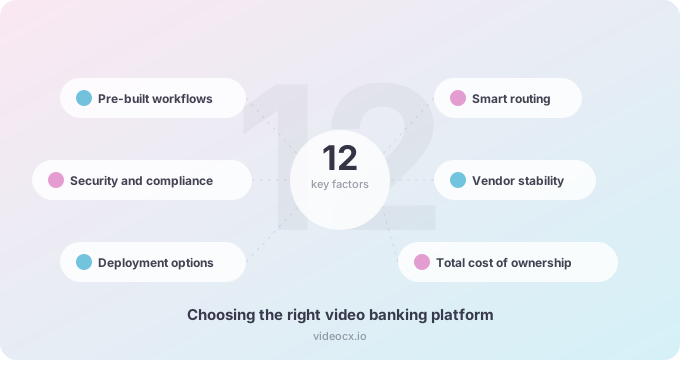
Selecting enterprise software is never simple, but when it comes to video banking platforms, the stakes are uniquely high. You’re not just choosing a technology tool. You’re selecting the infrastructure that will handle your most sensitive customer interactions, support complex financial transactions, and potentially define your competitive position for years to come.
The global enterprise software market reached $263.79 billion in 2024 and is projected to hit $517.26 billion by 2030, growing at 12.1% annually. Within this massive market, making the wrong choice is expensive. Not just in licensing costs, but in lost time, failed implementations, and missed business opportunities.
So how do you evaluate video banking platforms effectively? Here are the key factors that separate platforms that transform your business from those that become expensive regrets.
1. Pre-Built Workflows vs. Build-It-Yourself Platforms
This is the single most important decision you’ll make, and it’s often overlooked until after the contract is signed.
Some video banking platforms are essentially communication tools. They give you video calling capability and leave you to figure out everything else. Opening a checking account? Build that workflow. Processing a loan application? Build that too. Handling credit card inquiries? You guessed it.
Other platforms come with pre-configured workflows specifically designed for banking operations. Different workflows for different account types, loan products, advisory services, and compliance requirements.
The difference in time to market is staggering. Building custom workflows for 10 to 15 banking products typically requires 12 to 18 months and $500K+ in development costs. Platforms with pre-built workflows can go live in weeks, not months.
Ask yourself: Do you want to be in the video platform development business, or do you want to deliver video banking services to customers?
If the answer is the latter, prioritize platforms with proven, tested workflows for your specific products and services. Look for platforms that have already solved the problems you’re about to encounter, with a wide range of pre-configured product journeys that have been tested across multiple financial institutions.
Evaluation Criteria | Build-It-Yourself (Generic Video SDK) | Purpose-Built Video Banking Platform |
Time to Market | 12–18 months of development | 4–8 weeks typical deployment |
Workflow Availability | Custom-built from scratch | Pre-configured banking journeys |
Compliance Readiness | Must design and validate internally | Designed with financial compliance in mind |
Integration Effort | Heavy internal engineering effort | API-first with banking integrations |
Security Architecture | Requires custom hardening | Pre-validated security frameworks |
Ongoing Maintenance | Managed by internal teams | Vendor-managed updates & enhancements |
Feature Updates | Slow, project-based releases | Continuous feature releases |
Scalability Risk | Depends on internal infrastructure | Proven deployments across institutions |
Total Cost of Ownership | High upfront + ongoing dev costs | Predictable subscription model |
Operational Risk | High during build phase | Lower due to tested workflows |
2. Deployment Options: SaaS, Hybrid, or Dedicated Infrastructure
How and where your video banking platform runs matters more than you might think. The wrong deployment model can create security concerns, compliance issues, and unexpected costs.
SaaS (Software as a Service): The platform runs in the vendor’s cloud environment. You access it, but the vendor manages the infrastructure. This is typically the fastest to implement and requires the least internal IT resources.
Hybrid: The platform runs in the vendor’s cloud, but your sensitive data (videos, images, customer information) is stored in your own cloud storage. This gives you control over your most critical assets while still benefiting from managed services.
Dedicated Infrastructure: The entire platform runs in your AWS or Azure account on dedicated infrastructure. You have complete control and visibility into every aspect of the system.
Cloud subscription revenue accounted for 60.1% of the overall enterprise software market in 2024, showing the industry trend. But for banks, the choice isn’t just about following trends. It’s about balancing control, compliance, cost, and capability.
Consider your bank’s specific requirements. If you’re a large institution with strict data residency requirements or regulatory constraints, dedicated infrastructure may be non-negotiable. If you’re a regional bank looking for fast time to market, SaaS might be ideal.
The best video banking platforms offer all three options, letting you choose based on your needs rather than forcing you into their preferred model.
3. Integration Capabilities with Your Existing Systems
A video banking platform doesn’t exist in isolation. It needs to work seamlessly with your core banking system, CRM, document management, compliance systems, and authentication infrastructure.
Poor integration is where implementations die. The video call works great, but the data doesn’t flow back into your core banking system. Agents can’t see customer history during calls. Documents captured on video calls require manual data entry into other systems.
When evaluating platforms, look for:
Open API Architecture: Can the platform integrate with any third-party system via APIs? Or are you limited to a handful of pre-approved integrations?
Pre-Built Integrations: Does the platform already integrate with common banking systems like Google Maps, or face recognition services? These save months of integration work.
Data Sync Options: How does data flow between the video platform and your other systems? Real-time APIs? Batch processing? Message queues like Amazon SQS?
User Access Management: Can the platform integrate with your existing AD, ADFS, or Azure AD for centralized user management? Or do you need to maintain separate user databases?
The most flexible platforms are based on open API structures that can integrate virtually any system through standard protocols. They should provide detailed API documentation and support for your integration team.
4. Security and Compliance Architecture
For banks, security isn’t optional. It’s the foundation everything else is built on. But not all video banking platforms treat security with the rigor that financial institutions require.
When evaluating security, look beyond basic claims like “enterprise-grade encryption” or “SOC 2 compliant.” Dig into the architecture.
Data Encryption: Look for AES-256 encryption for data at rest and TLS 1.2 or higher for data in transit, aligned with U.S. financial security standards. Sensitive information such as Social Security numbers (SSNs), account numbers, and authentication tokens should be protected using application-level or payload-level encryption to support compliance with GLBA and FFIEC guidelines.
Network Architecture: How is the platform structured? Look for multi-AZ architectures on AWS or Azure with dedicated VPCs, network firewalls with IDS/IPS capabilities, and proper network segmentation between public-facing and backend systems.
Audit Trail: Every interaction should generate a complete, immutable audit trail. Call recordings, chat transcripts, documents shared, forms filled, decisions made. All with timestamps and user attribution.
Compliance Testing: Has the platform passed security audits from other banks? Look for platforms that have successfully completed VAPT (Vulnerability Assessment and Penetration Testing) for 20+ financial institutions. If it passes their InfoSec teams’ scrutiny, it’s more likely to pass yours.
Regular Security Updates: How often does the vendor conduct security testing? Annual VAPT should be the minimum. Continuous security monitoring using tools like AWS GuardDuty and Security Hub is even better.
The best platforms don’t just claim to be secure. They can provide detailed architecture diagrams, audit reports, and references from other banks’ InfoSec teams.
5. Feature Velocity and Product Roadmap
Technology moves fast. Customer expectations move faster. A platform that’s perfect today but doesn’t evolve becomes a liability within a year.
When evaluating platforms, understand their feature release cycle. How often do they ship new capabilities?
Banks that build in-house typically release new features quarterly at best. Generic video SDKs release features for all industries, not specifically for banking. Purpose-built video banking platforms should release banking-specific features every 45 days.
This isn’t just about quantity. It’s about whether the platform is actively solving problems you haven’t encountered yet. Are they adding features that respond to changing regulations, new customer expectations, and competitive pressures?
Look at the vendor’s track record. Not their promises, but their actual release history. Have they been consistently shipping meaningful improvements? Or have they been maintaining the status quo?
Also consider whether the platform is the vendor’s core business or a side project. Companies that focus exclusively on video banking for financial institutions will invest more in banking-specific innovation than companies for whom video banking is one product among many.
6. Scalability and Performance Under Load
Video banking platforms must handle unpredictable traffic patterns gracefully. Evaluate how many simultaneous calls the platform handles in production (not theory), whether it maintains quality across multiple geographies, if infrastructure auto-scales during peak periods, and what’s the largest proven deployment.
Look for platforms processing millions of video sessions monthly across dozens of institutions. Connection times under 10 seconds should be standard. The platform should handle dropped connections with session persistence and reconnection capabilities.
7. Customer Routing and Queue Management Intelligence
Not all video banking platforms understand the complexity of routing customers to the right specialists. Smart routing logic makes video banking efficient for both customers and agents.
Look for skills-based routing (product expertise, language, specializations), priority routing for VIP customers, intelligent queue management with wait time visibility, dynamic routing when groups are overwhelmed, and context preservation so agents see customer information before the video starts. Good routing can improve customer wait times, first-call resolution, and agent productivity by 30 to 40%.
8. Browser and Device Compatibility
One of the biggest barriers to video banking adoption is forced app downloads. The best platforms support both browser-based access (Chrome, Safari on any device with zero downloads) and native app integration (lightweight WebView SDKs under 100KB).
Verify cross-browser compatibility, mobile browser support, and that the platform uses WebRTC without requiring plugins. Universal access is the difference between 60% adoption and 30% adoption. Every barrier you remove drives higher usage.
9. Vendor Stability and Long-Term Viability
You’re selecting a strategic platform that could remain in production for five to ten years. Vendor stability matters.
Look for vendors serving 25+ banks with millions of video sessions monthly. Check their financial backing, customer retention rates, and geographic presence. A vendor with both US and international operations demonstrates global reach and staying power. Ask for customer references and verify that banks similar to yours have had successful, long-term implementations.
10. Total Cost of Ownership and ROI Timeline
Price is important, but total cost of ownership is what actually impacts your budget. Consider licensing structure (per agent, per call, flat fee), implementation costs, integration expenses, ongoing maintenance, and opportunity costs of delayed deployment.
According to research, agile transformation in banking typically follows an 18 to 24 month timeline, but video banking platforms should deliver value much faster. Look for platforms that can go live in 4 to 6 weeks for standard deployments, with measurable benefits appearing within the first quarter.
11. Support, Training, and Customer Success
When something breaks during a critical customer interaction, you need immediate support. Evaluate whether support is 24/7/365, response times for critical issues (minutes, not hours), and whether you get dedicated customer success resources for enterprise deployments. Talk to current customers about their actual support experiences, not just the vendor’s promises.
12. Proven Success with Similar Institutions
Has the platform delivered results for institutions like yours? Review its banking, lending, insurance, and financial services case studies to assess real-world performance. A solution that works well for a regional credit union may not scale for a national bank. Speak with peer institutions similar in size and market, and ask about use cases implemented, deployment timelines, challenges faced, and measurable outcomes achieved. Past success with comparable institutions is the strongest indicator of future reliability.
Making the Decision
Choosing a video banking platform is a strategic decision that will impact your customer experience and competitive position for years. Build a cross-functional evaluation team from IT, security, operations, compliance, and business units. Create a weighted scorecard that reflects your priorities.
Don’t just evaluate features. Evaluate the complete ecosystem: technology, security, support, vendor stability, and proven results. The difference between an adequate platform and a great one shows up in implementation speed (weeks versus months), total cost of ownership, and long-term vendor partnership quality.
With the U.S. enterprise software market expected to reach $222.86 billion by 2034 and 55% of bank customers using mobile apps as their primary channel, the time to act is now. Banks that move decisively on video banking with the right platform will capture customers who expect digital convenience with human expertise.
Make your choice carefully, strategically, and make it count.