

Banks spend millions trying to sell new products to existing customers through email campaigns. The results are poor. GetResponse’s 2024 Email Marketing Benchmarks show that financial services email campaigns convert at less than 3%. Yet banks keep running them, while ignoring something far more powerful: the service call already happening.
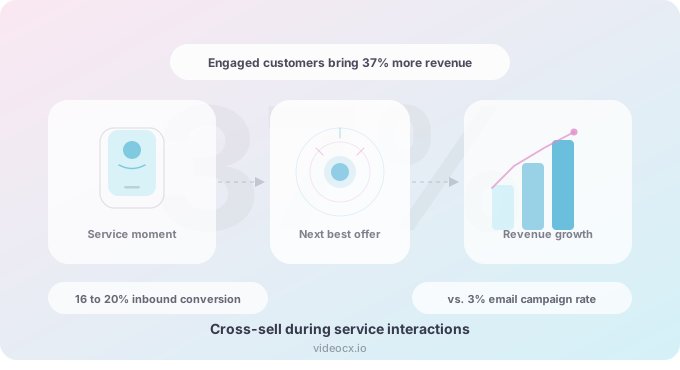
When a customer calls about a fraud alert, joins a video session with their relationship manager, or chats in to dispute a charge, they are already engaged, already identified, and already trusting the institution enough to reach out. Gallup’s retail banking research finds that fully engaged bank customers bring in 37% more annual revenue than disengaged ones, an extra $402 per year on average, rising to $869 for mass affluent clients. That engagement happens during service moments. The revenue rarely follows.
McKinsey research shows that personalized, well-timed engagement can cut acquisition costs by up to 50% and grow revenues by 5 to 15%. The opportunity is not finding new customers. It is doing more with the ones already on the line.
Why Cross Sell in US Banks Usually Fails
Most banks copy their campaign playbook into service channels: pick a product, push it at the end of every call, track how many agents complied. It does not work. Here is why.
Scripts ignore context. A customer who just spent twelve minutes sorting out a fraud dispute is not ready to hear a credit card pitch. Pushing one anyway damages trust rather than building it.
Sales quotas create the wrong pressure. When agents are evaluated on how many products they attempt to sell per shift, conversations stop feeling like service and start feeling like a transaction. Customers notice immediately. After the Wells Fargo scandal, the CFPB has made mis-selling a serious enforcement priority, and banks that tie agent bonuses to product volume face real regulatory risk.
Data does not reach the agent. A typical US regional bank runs on three to five separate core systems. None of them talk to each other in real time. An agent handling a mortgage servicing call has no idea that the same customer has been looking at home equity options in the mobile app all week.
Timing is wrong. McKinsey’s next best experience research confirms that pushing offers to customers who still have an open service issue actively hurts conversion and NPS. Fix the problem first. Then, if the moment is right, make the offer.
Why Service Moments Convert Better Than Campaigns
Three things make live service interactions a better selling environment than any outbound campaign.
People trust live conversations. A product suggestion from a banker during a service call feels like advice. The same suggestion in an email feels like an ad. McKinsey’s omnichannel banking research shows inbound service-to-sales programs generating conversion rate gains of over 15% alongside 10%+ overall sales growth. In banking, inbound conversion rates run at 16 to 20%, compared to just 2 to 8% for outbound campaigns, per Fatgraphs’ financial services conversion analysis.
The interaction tells you what the customer needs. A customer asking to raise their credit limit is showing a cash need. A customer calling about an overdraft is showing a budgeting gap. These are real-time signals that no batch data model can replicate.
Service quality is now a competitive edge. The ACSI Finance Study 2023–2024 found that customer service quality, not product range or app features, is now the top satisfaction driver in US retail banking. McKinsey’s experience research puts a number on it: banks with strong customer experience scores delivered 55% higher total shareholder returns over ten years than weaker performers.
The PRISM Framework: Five Things Banks Need to Get Right
Pillar 1: Unified Customer Data. Agents need one view of the customer, deposit history, credit behavior, recent app activity, service history available in real time when the call starts. Nightly batch updates are not enough. U.S. Bank saw a 127% increase in new accounts booked after connecting data across ten business lines into a single real-time platform. The data infrastructure is the product.
Pillar 2: A Next Best Offer Engine. This is the system that looks at what the customer just did, what they need, and what they qualify for and surfaces one or two relevant offers, not a menu of products. McKinsey documents that banks connecting real-time behavioral signals with customer profiles nearly tripled commercial campaign conversion rates. The engine must also automatically exclude customers who are in hardship, collections, or any status where an offer would be inappropriate under CFPB guidelines.
Pillar 3: Live Interaction Signals. The offer engine cannot just read pre-call data. It needs to know what is happening right now, why the customer called, how the conversation is going, how long it has been running. A customer who sounds frustrated five minutes in should not get a product offer until the problem is solved.
Pillar 4: Agent Assist Tools. The offer needs to reach the agent in a usable form: what triggered the recommendation, how to bring it up naturally, and a simple one-click path to start an application. McKinsey’s experience-led growth framework names this service-to-sales motion, helping the customer first, then uncovering a relevant need, as a core element of high-performing retail banking models.
Pillar 5: Compliance Guardrails. Every offer must clear a compliance check before it reaches the agent. That means suitability screening, suppression for at-risk customers, and a documented audit trail. In a CFPB examination environment, this is not optional. It is the foundation the whole program sits on.
Where Video Banking Changes the Game
FDIC data shows US bank branches have declined by nearly 24% over the past decade. But customers have not stopped wanting financial advice. They have moved to digital channels. Banks with secure video banking can meet that demand without the cost of a branch network.
Video does four things a phone call cannot.
It builds more trust. The Edelman Trust Barometer found that 62% of people now trust financial services companies, the first time the sector has crossed into “trusted” territory since 2008. That trust is built through human connection, and face-to-face video delivers it better than voice alone.
It removes the “I’ll think about it” exit. When a banker can walk a customer through a rate comparison or application on screen together, decisions happen in the moment. McKinsey data shows pre-approved offers convert at 1.8 times the rate of standard solicitations, and that gap widens when the offer is reviewed together rather than handed off.
It makes contextual offers feel natural. When agent assist prompts appear inside the video interface, the banker can raise a relevant product without it feeling scripted. McKinsey shows banks using life event triggers this way achieve 3.5 times more success than batch campaigns.
It creates a compliance record. Recorded video sessions with timestamped offer moments and captured consent give banks something phone calls cannot: documented proof that the offer was made appropriately. For institutions under CFPB scrutiny, that audit trail is a genuine risk management asset.
Three Real Scenarios
Fraud dispute leads to a credit card upgrade. A customer calls in about unauthorized charges. The agent resolves it in nine minutes. The system flags that this customer has run above 60% credit utilization for eighteen months and has never requested a limit increase. The agent mentions a cash-back rewards card that might work better for how they spend. McKinsey documents that service-to-sales programs can generate over 10% sales growth across channels within three months of launch.
Mortgage call opens a HELOC conversation. A customer calls to request an escrow review. The system shows their LTV is below 60%, their home has appreciated, and they have been browsing home improvement content in the app. The agent naturally raises a home equity line of credit as part of the conversation. McKinsey confirms that using real-time mobile browsing as a trigger signal produces significantly higher application rates than sending the same offer through a scheduled outbound campaign.
Video RM review surfaces a wealth advisory opportunity.During a quarterly video check-in, the relationship manager sees a prompt: this customer’s investable assets have grown year-over-year, but they have never spoken to the investment team. The RM brings it up within the existing conversation rather than handing it off to a cold outreach later. Gallup’s mass affluent research puts the revenue difference between engaged and disengaged mass affluent clients at $869 per year. The video RM session is the highest-value moment to close that gap.
What to Measure, and What to Avoid
Track service-to-sales conversion rate (well-run inbound programs in banking benchmark at 16 to 20% for high-intent triggers), revenue per interaction (the number that reframes the contact center as a profit center), offer acceptance rate as a share of offers made rather than total calls, and audit trail completeness as a compliance KPI,not just a reporting checkbox.
The most common mistakes: treating this as a training program rather than a data and systems project; launching without compliance controls in place; measuring campaign-level results instead of trigger-specific ones; and running the program on voice only. McKinsey finds that banks offering web chat see 1.4 times higher digital sales than those without it. Ignoring digital service channels means ignoring a large and growing share of the opportunity.
The Bottom Line
Fintech competitors like Chime and SoFi are winning on acquisition cost and digital experience. Traditional banks will not beat them at that game. But they can win on something fintechs struggle to replicate: a real, trusted relationship with existing customers.
McKinsey’s personalization research shows that faster-growing companies get 40% more of their revenue growth from personalization than slower peers. In banking, the best personalization opportunity is not the app home screen. It is the live service interaction, the moment when the customer is already there, already engaged, and already willing to listen.
Banks that build the right data, offer logic, agent tools, and video infrastructure around that moment will grow revenue from their existing book without increasing acquisition spend or regulatory risk. The service interaction is not a cost to manage down. It is the most valuable conversation a bank has with its customers.